


The case for a billionaire tax in California | Your Turn
The case for a billionaire tax in California | Your Turn

Jamshid Damooei, Your TurnSat, July 18, 2026 at 12:00 AM UTC
0
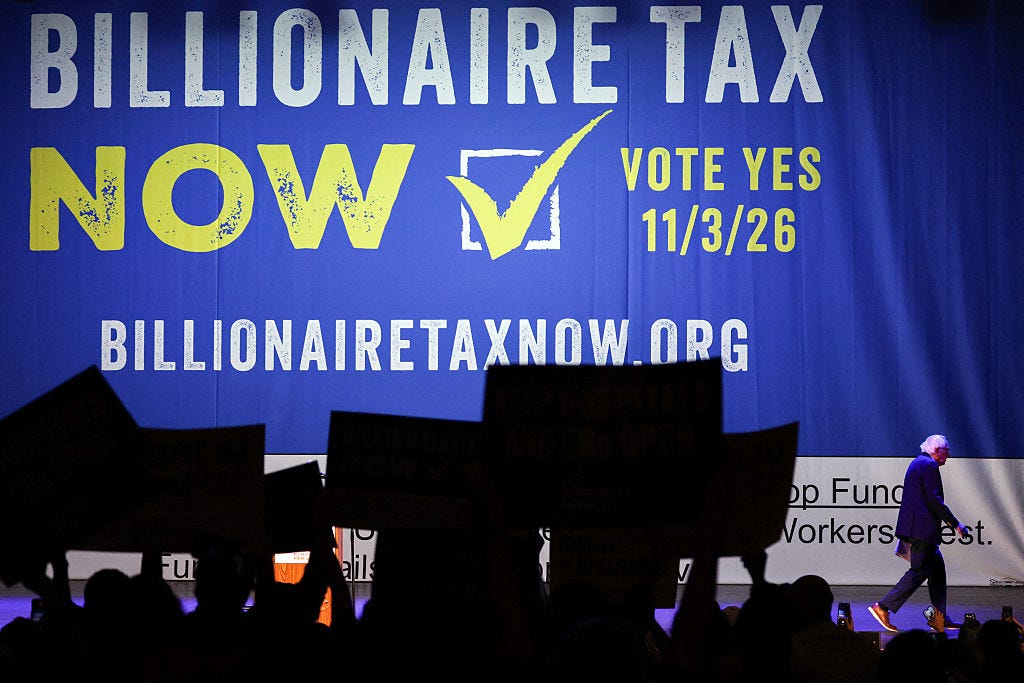
Americans who earn their living from wages and salaries pay higher effective tax rates than those whose wealth grows through investments. That imbalance lies at the heart of California's Proposition 40, which asks whether billionaires should pay a one-time 5% wealth tax to fund healthcare, education, and food assistance.
Acceptance and opposition largely hinge on what can be gained in the short term and what may be lost in the long term if some California billionaires leave the state. There are ample reasons to reject the notion that billionaires are or will be leaving California, yet some will still argue for it. Critics argue that current tax structures allow billionaires to pay low effective tax rates, depriving the state of revenue needed to address budget shortfalls caused by the One Big Beautiful Bill Act (OBBBA).
Why billionaires do not pay their fair share of federal or state taxes should be explained, discussed, and debated extensively across the nation. Over the past 50 years, tax rates have increasingly favored higher-income earners and their sources of income. Individual income tax rates have generally remained above the capital gains tax rate. Since the late 1970s, capital gains tax rates have declined significantly and have stayed low.
However, the favorable tax rate for the rich is only one side of this story. The more pressing and less discussed side is that tax laws clearly favor the wealthy and disadvantage working people. Much of the ultra-rich's wealth consists of unrealized capital gains, stocks, real estate, or business holdings that have appreciated but haven't been sold. Billionaires can live off loans secured by assets instead of selling them, thereby avoiding capital gains tax indefinitely.
The ultra-wealthy often borrow money by pledging appreciated assets as collateral to fund their lifestyles. These loans are not taxed as income, providing access to wealth without triggering taxable events. Upon their deaths, their heirs inherit the assets at market value, erasing prior gains for tax purposes.
Billionaires received preferential treatment for certain types of income: the carried interest loophole and the capital gains rates paid by private equity and hedge fund managers on what is effectively compensation. Stock options and deferred compensation structures allow executives to defer income, thereby minimizing their tax liability.
Tax shelters, deductions, and offshore strategies are common and widely used by wealthy households, who employ the best tax planner to create trusts, shell companies, offshore accounts, and charitable foundations that avoid paying tax while pursuing their interests.
Advertisement
Payroll taxes are primarily based on earned income, and Social Security and Medicare taxes apply mainly to wages. In 2025, the wage base was capped at $168,600, so income above that level was exempt from payroll taxes, while lower earners paid these taxes on all their income.
The real tragedy is that our system treats the surge in billionaire wealth as a sign of success, even though that concentration of wealth is lethal to our democracy. Billionaires can buy elections and use their financial support to defeat any political actions that might lead to decisions against their interests. Our tax policies over the last several decades have favored capital over labor, thanks to lobbying, resulting in the passage of such favorable laws and a decrease in the top marginal tax rate from 91% in the 1950s to 37% today. The Bush and Trump tax cuts reinforced this disparity, disproportionately benefiting high-income earners over the lower and middle classes.
The current political environment continues to shield billionaires and mega-corporations at the expense of everyone else. Yet most Americans may not realize they have nothing to lose and everything to gain by demanding that the ultra-wealthy pay their fair share. Breaking this status quo is not a burden; it is a profound relief. It unlocks vital revenue to fund our communities, ease everyday financial strain, and finally build a society that supports all its citizens.
Finally, those who believe the billionaires will leave the state should know that, according to a recent Oxfam America report, the wealth of the 10 richest California billionaires grew by nearly 50% over the past year, equivalent to an hourly wage of $16.3 million. The same report indicates that the collective wealth of California’s 246 billionaires, $2.061 trillion, is equal to nearly half (48.5%) of California’s 2025 GDP.
The claim that we fear a one-time 5% tax on billionaires that would force them to leave the state is unlikely to be true, but the political paralysis and divide it creates are real. Proposition 40, in essence, asks a more important question: Should a tax system continue to reward wealth more generously than work, or should those who have benefited most from our economy contribute more to the public investments that sustain it?
Jamshid Damooei, Ph.D., is a professor and executive director of the Center for Economics of Social Issues (CESI) at California Lutheran University. For more information on the comprehensive study “California’s Housing Crisis: Roots of the Problem and What Lies Ahead,”
This article originally appeared on Ventura County Star: Capital gains vs. working pains: the case for a billionaire tax
Source: “AOL Money”
